



Aldose Reductase
AKR1B1; Aldo-keto reductase family 1 member B
Aldose reductase is a small, cytosolic, monomeric enzyme which belongs to the aldo-keto reductase superfamily. Aldose reductase catalyzes the reduced form of nicotinamide adenine dinucleotide phosphate (NADPH)-dependent reduction of a wide variety of aromatic and aliphatic carbonyl compounds. It is implicated in the development of diabetic and galactosemic complications involving the lens, retina, nerves, and kidney.
Aldose reductase is both the key enzyme of the polyol pathway, whose activation under hyperglycemic conditions leads to the development of chronic diabetic complications, and the crucial promoter of inflammatory and cytotoxic conditions, even under a normoglycemic status. Aldose reductase represents an excellent drug target and a huge effort is being done to disclose novel compounds able to inhibit it.
All Product Categories
-
Aldose Reductase Related Products (134)
Related Products (134)

-
Antibodies (2)
-
M79175
 0 ImagesCat. No.: HY-129685CAS No.: 82319-87-7M79175 is an aldose reductase inhibitor that can be used in the study of early diabetic retinopathy.
-
Soyasaponin Bb (Standard)
 0 ImagesCat. No.: HY-N0310RCAS No.: 51330-27-9Soyasaponin Bb (Standard) is the analytical standard of Soyasaponin Bb (HY-N0310). This product is intended for research and analytical applications. Soyasaponin Bb is an orally active, covalent inducer of heme oxygenase HO-1 and an inhibitor of aldose reductase AKR1B1. Soyasaponin Bb can regulate oxidative stress pathways, enhance antioxidant capacity, reduce reactive oxygen species (ROS) generation, and inhibit lipid peroxidation and hepatocyte apoptosis. Soyasaponin Bb improves alcohol-induced hepatocyte membrane damage and liver function abnormalities, and improves Scopolamine (HY-N0296)-induced memory impairment. Soyasaponin Bb has antioxidant, hepatoprotective, and neuroprotective activities.
-
Esmolol
 0 ImagesCat. No.: HY-B1392ACAS No.: 81147-92-4Esmolol is an ultra-short-acting cardioselective β1-adrenergic blocker. Esmolol exerts its antiarrhythmic effect by activating Neurokinin 1 Receptor. Esmolol attenuates post resuscitation myocardial dysfunction. Esmolol improves diabetic wound healing by inhibiting aldose reductase and the production of advanced glycation end products and promoting fibroblast migration. Esmolol can be used to study cardiac diseases such as arrhythmias and diabetic foot ulcers.

-
2-(2-Chlorobenzamido)acetic acid
 0 ImagesCat. No.: HY-W014242CAS No.: 16555-60-52-(2-Chlorobenzamido)acetic acid is an aldose reductase inhibitor with an IC50 of 31 μM. 2-(2-Chlorobenzamido)acetic acid can be used for the research of chronic diabetes.
-
WF-2421
 0 ImagesCat. No.: HY-183855CAS No.: 128429-19-6WF-2421 is an aldose reductase inhibitor with an IC50 of 0.03 μM against rabbit-derived aldose reductase. WF-2421 acts as a non-competitive inhibitor of aldose reductase using dl-glyceraldehyde as the substrate. WF-2421 can be used in the research of diabetic complications (cataract, neuropathy, retinopathy, nephropathy).
-
Isoliquiritigenin (Standard)
 0 ImagesSynonyms: GU17 (Standard); ISL (Standard); Isoliquiritigen (Standard); SJ000286237 (Standard)Isoliquiritigenin (Standard) is the analytical standard of Isoliquiritigenin. This product is intended for research and analytical applications. Isoliquiritigenin is an anti-tumor flavonoid from the root of Glycyrrhiza uralensis Fisch., which inhibits aldose reductase with an IC50 of 320 nM. Isoliquiritigenin is a potent inhibitor of influenza virus replication with an EC50 of 24.7 μM.
-
Aldose reductase-IN-7
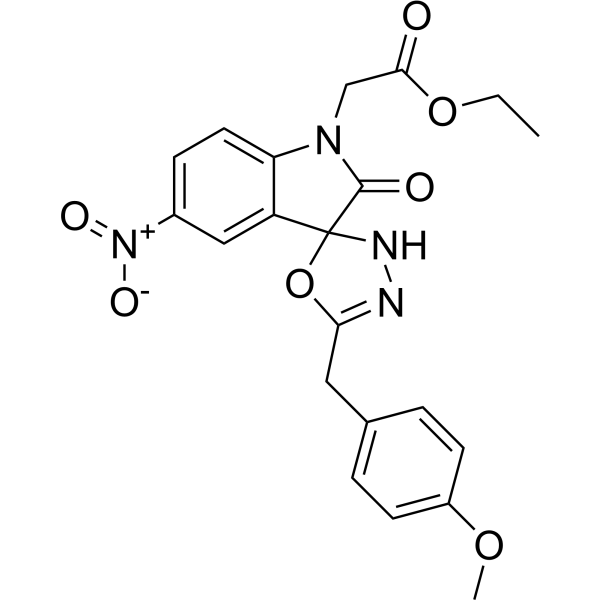 0 ImagesCat. No.: HY-161472Aldose reductase-IN-7 (Compound 6k) targets Aldose reductase. Aldose reductase-IN-7 exhibits potent enzyme inhibitory activity (Ki = 0.186 ± 0.020 μM), showing superiority to Epalrestat (HY-66009), which is currently in clinical use. Aldose reductase-IN-7 is less cytotoxic and possesses potent anticancer activity.
-
Ponalrestat (Standard)
 0 ImagesCat. No.: HY-106697RCAS No.: 72702-95-5Synonyms: ICI 128436 (Standard)Ponalrestat (Standard) (ICI 128436 (Standard)) is the analytical standard of Ponalrestat (HY-106697). This product is intended for research and analytical applications. Ponalrestat (ICI 128436) is an orally active, selective and noncompetitive aldose reductase (AKR1B1; ALR) inhibitor. Ponalrestat selectively inhibits ALR2 (Ki=7.7 nM) over ALR1 (Ki=60 μM). Ponalrestat inhibits the conversion of glucose to sorbitol.
-
AL-4114
 0 ImagesCat. No.: HY-116600CAS No.: 139911-05-0AL-4114 is an aldose reductase inhibitor which can be utilized in research related to the prevention of diabetic cataractogenesis.
-
ALO1567
 0 ImagesCat. No.: HY-119842CAS No.: 97677-19-5Synonyms: AL1567ALO1567 (AL1567) is an orally available aldose reductase inhibitor with an IC50 of 27 nM for rat lens aldose reductase. ALO1567 can be used in the research of diabetes.
-
Rhetsinine
 0 ImagesCat. No.: HY-W715538CAS No.: 526-43-2Rhetsinine is an aldose reductase inhibitor isolated from Evodia rutaecarpa, exhibiting an IC50 value of 24.1 μM. At a concentration of 100 μM, rhetsinine significantly inhibits sorbitol accumulation by 79.3%. This compound shows potential for research in diabetic complications, including diabetic neuropathy and retinopathy.
-
Epalrestat-d5
 0 ImagesCat. No.: HY-W653944CAS No.: 2755644-33-6Synonyms: ONO2235-d5Epalrestat-d5 is deuterium labeled Epalrestat. Epalrestat is an orally active aldose reductase inhibitor that acts on diabetic neuropathy.
-
Salfredin A7
 0 ImagesCat. No.: HY-N14450CAS No.: 139542-55-5Salfredin A7 is an aldose reductase inhibitor.




